I’m Laurence Cole, an EU Project Specialist with Momentum Educate + Innovate, where I’ve managed and contributed to more than 15 Erasmus+ projects across areas including inclusion, rural development, youth and digital competencies. My academic background is in Business Psychology, where I graduated with First Class Honours, and I’ve always been particularly interested in how people behave, learn, communicate and work together.
That is probably why the area of “soft skills”, or people skills, has always interested me most. In organisational psychology, these are the kinds of skills that shape how people communicate, collaborate, solve problems, adapt and lead – which brings me neatly to transversal skills.
But first, what is a transversal skill? Transversal skills are recognised as skills that can be used across different roles, subjects and situations, rather than being linked to one specific profession or technical task. They include skills such as communication, teamwork, critical thinking, problem-solving, creativity, adaptability and self-management.
Teachers who practice these skills with students often enable their students success in the future – you might have had a teacher that reminds you of Robin Williams in Dead Poets Society.
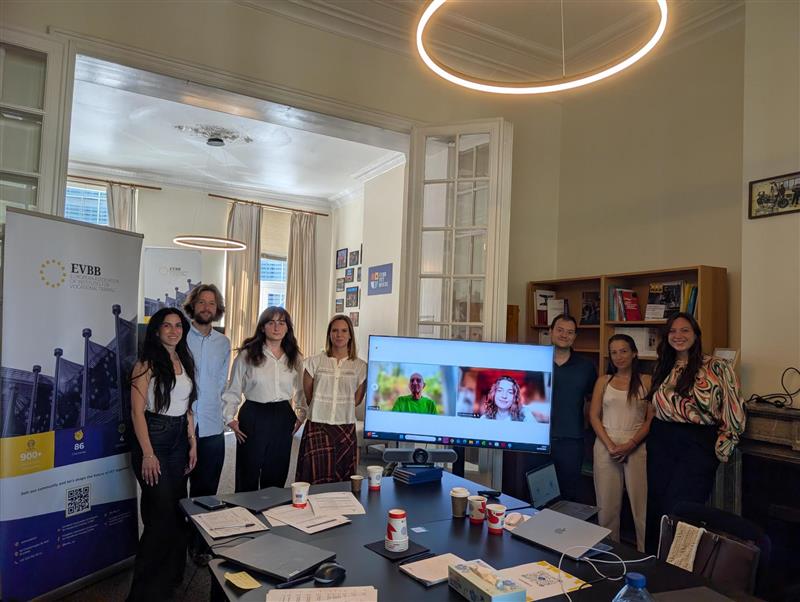
Within my work in Momentum, I work on a lot of different types of projects, but not always does that business psychology itch get scratched. Over the last three years, I have worked on the VET Compass project, a project that aims to improve the teaching of transversal skills in Vocational Education & Training (VET). I remember meeting the partners (EVBB, Skills Together, BK-CON, Innoved, ENAIP, AKMI and I&F) for the first time and being ultra excited at the concept.
Those that know me, know I tend to get quite enthusiastic, especially if it is something I am interested in.
Just wait for the Bee project coming soon – bee keeping, psychology, climate action and digital skills – yes please!
Three years on, VET Compass is coming to a close, and its focus feels increasingly relevant. Our research with 80 VET teachers and trainers and 40 in-depth interviews across four European countries found that transversal skills are widely recognised as essential, yet they remain inconsistently taught, poorly assessed and often absent from structured professional development. Problem-solving, communication, collaboration, motivation and adaptability emerged as some of the skills educators valued most.
That becomes particularly significant as automation and digitalisation reshape the workplace. Technical knowledge remains crucial, but our research also found that employers supervising VET placements frequently valued reliability, teamwork, initiative and openness to feedback as highly as, and sometimes more than, technical proficiency. As one educator put it: “You can teach someone how to do a job. But if they can’t work with people, adapt when something changes, or manage stress – they’ll struggle.”
VET Compass approached the challenge from a different angle: before educators can effectively develop transversal skills in their learners, they need a way to understand and assess those skills in themselves. The project therefore set out to identify the key transversal competences needed by VET professionals, develop a structured assessment framework around them, and translate that framework into an interactive, scenario-based assessment tool.
The idea was simple, even if the methodology behind it was more complex: give educators a meaningful way to reflect on how they communicate, solve problems, adapt, collaborate and respond to realistic workplace situations – and then connect that insight to opportunities for professional development.
VET Compass has launched several different resources that will help educators to improve their transversal skills in the classroom:
The Transnational Report on Transversal skills- this report highlights our research conducted at the start of the project, highlighting what the top 10 transversal skills are, and how they could be taught in a classroom. This report was comprised of desktop and primary research, where over 150 European educators highlighted their experiences.
The VET Compass Transversal Skills Assessment Framework for VET Teachers/Trainers/Staff– this assessment framework gave us clarity and direction on how we could make the tool more relevant, accessible and impactful to VET Educators.
The Game Based Assessment tool- this was a central goal of our project: to develop a game-based assessment tool that encourages educators to reflect on and strengthen their transversal skills, rather than simply judging whether their existing skills are strong or weak.
The Toolbox Library and Roadmap– this is the final output of the project, a toolkit with OERs, Case Studies and Tools, all aiming to help improve your transversal skills in the classroom. The roadmap is designed to help give educators and administrators direction on how they can encourage their institutions to have a stronger adaptation of transversal skills.
As I’ve worked on VET Compass, I’ve often thought back to one of my own lecturers, Joe Egan, probably my closest real-life version of Robin Williams in Dead Poets Society. We had Joe for marketing modules, but what stayed with me most were the stories he told about people, relationships and the world beyond the textbook. He had a way of taking the marketing concepts we were covering and expanding them into something much more human.
He once commented that my then-girlfriend (who he also taught on a different class) I sounded like a “power couple”. A few days from now, we’ll celebrate our first wedding anniversary, so perhaps he was onto something.
For me, that captures why transversal skills are so important. The teachers we remember are often the ones who knew how to communicate, encourage, challenge, connect and help us see things differently.
That is what VET Compass has tried to support: giving educators practical ways to recognise, reflect on and strengthen those skills in their own practice.
If you work in VET, take a look at the new VET Compass resources and see which transversal skills you already use every day , and which ones you might want to develop further.
Because sometimes the skills that shape a career are the ones that never appeared on the syllabus.
“We are moving from the knowledge economy to the wisdom economy. AI can provide information, but humans provide context, empathy, and creative connection.”
-Modern workforce insight
Laurence, EU Project Specialist, Momentum.